
By
Simon Hazeldine
Most deals do not stall because the buyer suddenly loses interest.
They stall because momentum quietly disappears.
The meeting felt positive.
The buyer seemed engaged.
The opportunity looked real.
Then suddenly:
“We need more time.”
“We’re reviewing internally.”
“Let’s reconnect next month.”
And the seller’s response?
Chasing.
Following up.
Checking in.
Sending “just circling back” emails.
The problem is not the follow-up itself.
The problem is that momentum was never truly secured in the first place.
Because deal slippage is rarely about timing.
It is about loss of forward motion.
The Hidden Danger of Passive Pipeline
Most stalled deals do not feel stalled at the beginning.
That is what makes them dangerous.
They often look healthy:
Good conversations
Positive feedback
Friendly interactions
But underneath the surface, something critical is missing:
Commitment.
Not verbal enthusiasm.
Behavioural commitment.
Because buyers do not move deals forward through interest alone.
They move them forward through action.
And when action slows, momentum decays.
Why Momentum Matters
Momentum changes psychology.
When a deal is moving:
Energy increases.
Attention increases.
Priority increases.
People feel progress.
But when momentum slows:
Urgency fades.
Internal focus shifts elsewhere.
Competing priorities take over.
The deal loses emotional energy.
And emotional energy is what sustains decisions.
The Real Mistake Sellers Make
Most sellers try to manage momentum through reminders.
Elite sellers manage momentum through structure.
There is a difference.
Average sellers rely on:
“Just checking in…”
“Any updates?”
“Have you had a chance to review?”
These messages create pressure without movement.
Elite sellers do something else.
They build a system of forward motion into every interaction.
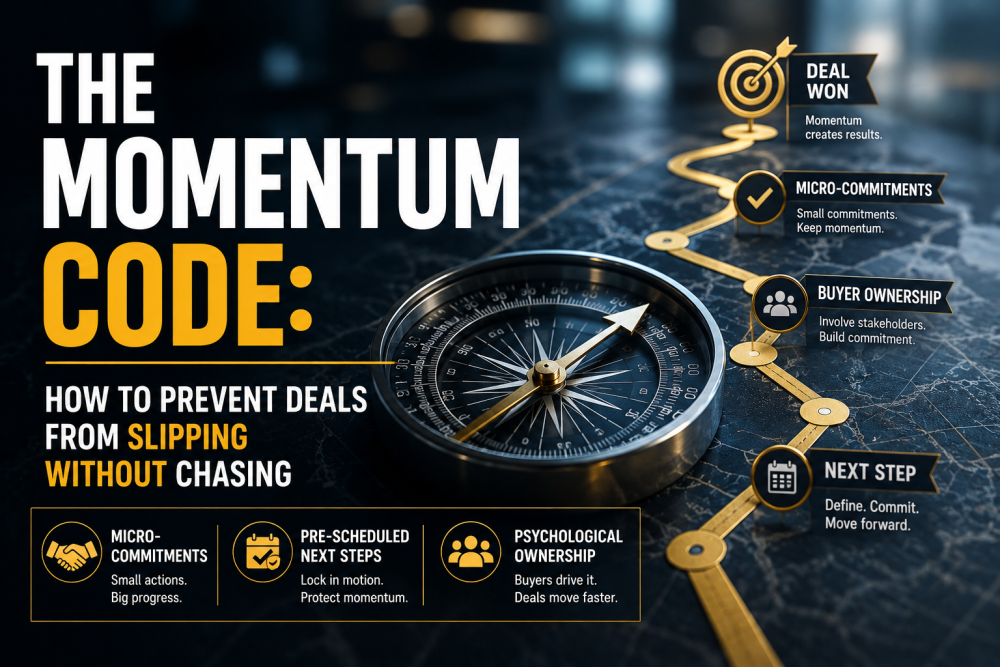
The Momentum Code
High-performing sellers understand that momentum is built through three disciplines:
- Micro-commitments
- Pre-scheduled next steps
- Psychological ownership
Together, these create what I call the Momentum Code.
1. Micro-Commitments: The Engine of Progress
Most sellers ask for outcomes that are too large, too early.
Instead, elite sellers secure small commitments consistently.
Why?
Because small commitments create movement.
And movement creates momentum.
Examples of micro-commitments include:
• Agreeing to involve another stakeholder
• Reviewing a document before the next meeting
• Sharing internal success criteria
• Scheduling a workshop
• Providing access to data or systems
None of these close the deal.
But all of them advance it.
And crucially, they create behavioural investment.
Why Micro-Commitments Work
Psychologically, people value what they invest effort into.
When buyers take action, even small action, they begin to feel ownership of progress.
The deal stops feeling like:
“The seller’s proposal”
And starts feeling like:
“Our initiative”
That shift matters enormously.
Because people are more committed to what they help create.
2. Pre-Scheduled Next Steps: Never Leave Motion Undefined
One of the biggest momentum killers is ambiguity.
A meeting ends with:
“Let’s stay in touch.”
“Send that across.”
“We’ll reconnect soon.”
Nothing specific.
Nothing committed.
Nothing scheduled.
Momentum immediately weakens.
Elite sellers do not leave next steps vague.
They secure them while energy is highest, during the meeting itself.
For example:
“Based on today’s discussion, would it make sense to schedule a session next Thursday to review stakeholder feedback?”
This achieves several things:
• It creates structure
• It prevents drift
• It reinforces seriousness
• It maintains continuity
Most importantly, it keeps time working in your favour.
The Rule: Never End Without Motion
A sales conversation should never end without one of three things:
• A scheduled next action
• A defined decision point
• A clear reason why the deal should stop
Anything else creates pipeline fog.
And pipeline fog destroys forecast accuracy.
3. Psychological Ownership: The Hidden Accelerator
This is the most overlooked element of momentum.
Deals move faster when buyers emotionally own the process.
Not when sellers drive it alone.
The mistake many sellers make is over-owning the deal.
They:
Push
Chase
Drive every interaction
The result?
The buyer becomes passive.
Elite sellers create shared ownership instead.
How to Build Ownership
The key is involvement.
Ask questions like:
“How do you think this should be positioned internally?”
“What would success look like from your perspective?”
“Who else should shape this conversation?”
These questions do something powerful.
They move the buyer from observer to participant.
And participation increases commitment.
Momentum Is Emotional Before It Is Operational
This is important.
Momentum is not just about process.
It is about emotion.
When buyers feel:
Progress
Clarity
Movement
Involvement
Energy increases.
When they feel:
Confusion
Delay
Uncertainty
Passive waiting
Momentum collapses.
Language Patterns That Sustain Momentum
The language sellers use matters enormously.
Here are several high-impact patterns.
Instead of:
“Just checking in…”
Try:
“Last time we spoke, we agreed the priority was reducing implementation delays. Has anything changed internally since then?”
Why it works:
- References prior commitment
- Reinforces relevance
- Feels purposeful, not needy
Instead of:
“Any updates?”
Try:
“What feels like the next logical step from your perspective?”
Why it works:
- Encourages ownership
- Creates movement
- Keeps momentum collaborative
Instead of:
“Let me know when you’re free.”
Try:
“Would it make sense to lock in 30 minutes now while this is still fresh?”
Why it works:
- Protects momentum
- Reduces delay friction
- Uses current engagement energy
Meeting Closing Scripts That Create Momentum
The final two minutes of a meeting are critical.
This is where momentum is either secured or lost.
Here are several effective closing structures.
Closing Script 1: Commitment Reinforcement
“Just to summarise, we’ve agreed the key priority is improving X while reducing Y. The logical next step would be to involve your operations team to explore implementation impact. Does that feel right?”
Closing Script 2: Decision Momentum
“It feels like there’s alignment around the opportunity. What would need to happen internally for this to move forward confidently?”
Closing Script 3: Ownership Transfer
“Who else should we involve at this stage to make sure momentum continues internally?”
The Leadership Opportunity
Sales leaders often focus heavily on pipeline volume.
But momentum quality matters more.
A pipeline full of passive opportunities creates false confidence.
Leaders should inspect:
• Strength of next steps
• Buyer actions taken
• Stakeholder engagement
• Time gaps between meetings
• Evidence of ownership
Because momentum leaves clues.
The Momentum Scorecard
Use this simple diagnostic in pipeline reviews.
Score each opportunity 1–5:
Momentum Indicators
- Clear next meeting scheduled
- Buyer-owned actions agreed
- Multiple stakeholders engaged
- Recent movement within 7 days
- Defined business urgency
- Evidence of internal advocacy
Interpretation
24–30 → Strong momentum
16–23 → Moderate risk
Below 16 → Likely slippage risk
Case Example: The Deal That Recovered
A software company had a six-figure deal stall unexpectedly.
Positive meetings.
Strong interest.
Good technical fit.
But momentum disappeared.
Why?
No clear next steps.
No stakeholder expansion.
No buyer ownership.
The seller shifted approach.
Instead of chasing, they re-established momentum through micro-commitments:
• Scheduled a stakeholder workshop
• Asked the buyer to define success metrics internally
• Created a joint action plan
The energy returned.
The deal progressed.
Not because pressure increased.
Because movement returned.
Final Thought
Deals rarely die suddenly.
They drift.
Momentum weakens quietly before pipeline risk becomes visible.
That is why elite sellers do not rely on enthusiasm.
They build forward motion deliberately.
Through:
Micro-commitments
Structured next steps
Psychological ownership
Because momentum is not luck.
It is engineered.
And the sellers who understand the Momentum Code do not spend their time chasing deals.
They spend their time advancing them.
Subscribe to Simon Hazeldine’s
“More Sales, More Often, More Margin” newsletter.
Simon’s regular newsletter contains powerful and practical sales and negotiation
strategies, tactics, and tips to help you to grow your revenue and bottom-line profits.
About the author
Simon Hazeldine works internationally as a revenue growth and sales performance speaker, consultant, and coach. He empowers his clients to get more sales, more often with more margin.
He has spoken in over thirty countries and his client list includes some of the world’s largest and most successful companies.
Simon has a master’s degree in psychology, is the bestselling author of ten books that have been endorsed by a host of business leaders including multi-billionaire business legend Michael Dell and is co-founder of leading sales podcast “The Sales Chat Show”.
He is the creator of the neuroscience based “Brain Friendly Selling”® methodology.
Simon Hazeldine’s books:
- Neuro-Sell: How Neuroscience Can Power Your Sales Success
- Bare Knuckle Selling
- Bare Knuckle Negotiating
- Bare Knuckle Customer Service
- The Inner Winner
- How To Lead Your Sales Team – Virtually and in Person
- Virtual Selling Success
- How To Manage Your People’s Performance
- How To Create Effective Employee Development Plans
- Virtual Negotiation Success


