By
Simon Hazeldine
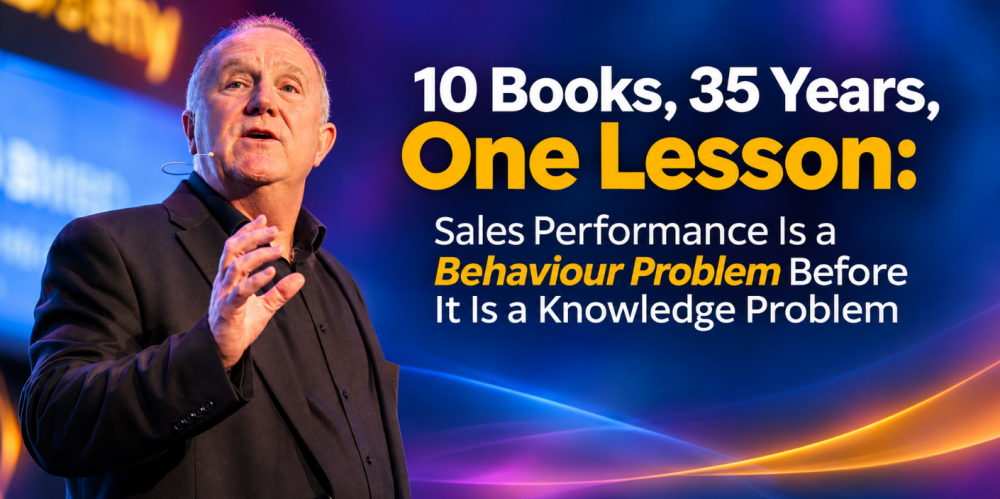
I have spent 35 years working in sales, sales psychology, sales training, negotiation, sales leadership and performance improvement.
I have written ten books.
Worked with many organisations across different industries and countries.
Delivered countless training sessions, workshops, coaching conversations and keynote speeches.
Studied psychology.
Explored neuroscience.
Worked with salespeople at different levels of experience and ability.
And after all of that, I keep returning to one fundamental lesson.
Sales performance is a behaviour problem before it is a knowledge problem.
Not always.
Knowledge matters.
Skills matter.
Experience matters.
But in many sales organisations, the biggest performance gap is not between what salespeople know and what they need to know.
It is between what they know and what they consistently do.
That distinction is enormous.
And it should fundamentally change how organisations approach sales training, coaching, leadership and performance improvement.
The Question That Changed My Thinking
Think about your sales team.
Ask your average performers:
Should you prepare properly before an important customer meeting?
Of course.
Should you ask good questions?
Yes.
Should you listen carefully?
Naturally.
Should you understand the customer’s business?
Absolutely.
Should you communicate value rather than features?
Yes.
Should you engage the economic buyer?
Of course.
Should you secure a clear next step?
Definitely.
Should you protect margin during negotiation?
Obviously.
Now ask yourself something.
If they know all of this, why aren’t they consistently doing it?
That is the question sales leaders should spend far more time answering.
Because the answer often has very little to do with how much information the salesperson possesses.
It has everything to do with what happens when knowledge collides with reality.
The buyer pushes back.
The clock is ticking.
The salesperson feels uncomfortable.
An important deal is at risk.
The manager wants the number.
And suddenly, the good practice they can explain perfectly in a training room disappears.
This is what I call the Knowing–Doing Gap.
And it is one of the most persistent performance problems in professional selling.
What Ten Books Have Taught Me
When I look across my ten books, I can see an evolution in how I have approached performance.
Different subjects.
Different commercial environments.
Different challenges.
But an increasingly consistent underlying theme.
Books such as Bare Knuckle Selling and Bare Knuckle Negotiating reflect the practical realities of selling and commercial pressure.
Neuro-Sell explores the relationship between neuroscience, psychology and sales success.
The Inner Winner addresses the human side of performance.
My books on sales leadership, performance management and employee development address what managers and organisations need to do to support improvement.
Virtual Selling Success and Virtual Negotiation Success address how performance behaviours must adapt when the commercial environment changes.
Even Bare Knuckle Customer Service connects with the wider importance of how people behave when interacting with customers.
Different topics.
One recurring challenge.
How do we get people to perform the right behaviours, consistently, in the situations where those behaviours matter most?
Because understanding a negotiation technique is not the same as using it.
Knowing how to coach is not the same as coaching.
Understanding buyer psychology is not the same as adapting your selling behaviour.
And knowing how to sell virtually is not the same as conducting an effective virtual sales conversation.
Knowledge creates possibilities.
Behaviour produces outcomes.
The Sales Knowledge Illusion
We live in an age of extraordinary access to information.
Salespeople can access:
Books.
Podcasts.
Training videos.
Online courses.
Sales methodologies.
Sales enablement platforms.
AI assistants.
CRM guidance.
Objection-handling playbooks.
Negotiation frameworks.
Customer research.
The knowledge available to modern salespeople is astonishing.
And generative AI has made accessing explanations, examples and advice easier than ever.
So here is an uncomfortable question.
If access to sales knowledge keeps increasing, why do organisations still struggle with inconsistent sales execution?
Because access to knowledge is not the same as mastery.
An AI assistant can generate ten excellent discovery questions.
That does not mean the salesperson will ask them.
A sales methodology can explain how to manage stakeholders.
That does not mean the seller will challenge their friendly contact and request access to the CFO.
A negotiation course can explain how to trade concessions.
That does not mean the seller will resist discounting when procurement applies pressure.
We sometimes confuse the availability of good advice with the existence of good behaviour.
They are not the same thing.
And in my experience, that confusion creates a great deal of wasted investment.
The Real Test Happens Under Pressure
Consider a salesperson negotiating a £250,000 deal.
They know perfectly well that an unearned discount damages margin.
They know they should pause.
Explore.
Re-anchor value.
Trade rather than give.
Then procurement says:
“Your competitor is 12% cheaper. Unless you can improve your price significantly, we may have to go elsewhere.”
Silence.
The salesperson feels the tension.
The deal matters.
The quarter matters.
Their manager is expecting the business.
Suddenly:
“I understand. Let me see what I can do.”
There goes the commercial discipline.
The knowledge was there.
The behaviour wasn’t.
Or imagine a discovery meeting.
The salesperson knows they should explore business impact.
The customer says:
“We need better visibility of our pipeline.”
The seller immediately thinks:
We have a dashboard for that!
And starts presenting.
They know they should ask more questions.
But the excitement of recognising a solution opportunity overrides their discipline.
Discovery stops.
Pitching begins.
Again, the knowledge existed.
The behaviour disappeared.
This is why I believe sales performance development must focus far more on what people can execute under real commercial conditions.
The Psychology Behind the Knowing–Doing Gap
Why does this happen?
Because human behaviour is influenced by far more than knowledge.
Several factors matter.
1. Habits
People develop familiar patterns of behaviour.
Under pressure, familiar responses can be easier to access than newly learned techniques.
If a salesperson has spent years responding to objections by talking faster and explaining more, one workshop will not automatically replace that habit.
2. Cognitive load
Live customer conversations place demands on attention and working memory.
The salesperson is listening, thinking, asking, interpreting, remembering and responding simultaneously.
If a new technique requires excessive conscious effort, it may become difficult to execute while managing everything else.
3. Emotion
Fear of rejection.
Need for approval.
Anxiety about losing a deal.
Discomfort with silence.
Excitement.
Pressure.
These can all change behaviour.
A salesperson may know exactly what the right response is but still avoid it because the response feels uncomfortable.
4. Confidence
Knowing what to do and believing you can do it are different things.
Rehearsal and successful experience can help close that gap.
5. The working environment
This is one of the most important factors.
A salesperson attends training about protecting value.
Then returns to a manager who says:
“Just get the deal closed.”
Guess which message influences behaviour?
The one repeatedly reinforced by the manager.
Knowledge is individual. Behaviour is also environmental.
And sales leaders ignore that distinction at their peril.
Elite Salespeople Do Not Necessarily Know More
We often imagine elite sellers possess extraordinary secrets.
Some do have deeper knowledge, broader experience or superior commercial judgement.
But that is not the whole story.
Frequently, elite sellers distinguish themselves through the consistent execution of fundamental behaviours.
They prepare when others improvise.
They ask another question when others start pitching.
They listen when others talk.
They challenge when others avoid discomfort.
They engage stakeholders when others remain with their friendly contact.
They secure commitments when others accept vague next steps.
They trade concessions when others give.
They rehearse when others rely on experience.
None of these behaviours is particularly mysterious.
But consistent execution creates a powerful advantage.
Elite performance is often ordinary good practice executed with extraordinary consistency.
That is not a particularly glamorous conclusion.
But it is commercially useful.
Because it means improvement may be more achievable than organisations assume.
We do not always need to discover an entirely new sales methodology.
We may need to help people consistently execute the fundamentals they already understand.
Why I Developed Brain Friendly Selling®
My work in sales psychology and neuroscience has reinforced the importance of understanding both sides of the sales conversation.
The buyer’s brain.
And the seller’s brain.
Much of traditional sales training focuses on what sellers should say or do.
But effective sales performance also requires understanding why buyers respond as they do.
How they pay attention.
How they evaluate relevance.
How they build trust.
How they process information.
How they perceive risk.
How they make decisions.
That is one side of Brain Friendly Selling®.
The other side concerns the salesperson.
How do they develop effective habits?
How do they manage pressure?
How do they maintain curiosity?
How do they communicate clearly?
How do they practise new skills?
How do they turn learning into behaviour?
These two areas are connected.
Because knowing how the buyer’s brain works only creates commercial value when the seller changes how they behave.
For example:
Understanding cognitive load is useful.
But the commercial benefit appears when the seller simplifies their presentation.
Understanding psychological safety is useful.
But the benefit appears when the seller changes their questioning and listening behaviour.
Understanding loss aversion is useful.
But the benefit appears when the seller explores perceived risk and the cost of inaction more effectively.
Understanding negotiation psychology is useful.
But the benefit appears when the seller pauses, explores and trades rather than giving concessions away.
Sales psychology becomes commercially valuable when it changes sales behaviour.
That is the connection.
Sales Training Has a Behaviour Change Problem
Over the years, I have seen many organisations invest heavily in sales training.
Some programmes are excellent.
Strong content.
Good models.
Useful exercises.
High-quality facilitation.
Positive participant feedback.
And yet the commercial impact is sometimes disappointing.
Why?
Because training is treated as an event.
A workshop.
A course.
A virtual session.
A keynote.
Something people attend.
But attending does not guarantee adopting.
Learning does not guarantee applying.
And practising something once does not guarantee it will survive pressure.
The problem is not always the training content.
It is what happens afterwards.
Or more accurately, what does not happen.
No consistent practice.
No behavioural triggers.
No manager coaching.
No reinforcement.
No measurement of adoption.
Then the organisation wonders why the training faded.
If sales leaders want better results, they must stop treating training delivery as the end of the process.
Training is the beginning of performance development.
Not the conclusion.
The Behaviour Bridge: How Knowledge Becomes Performance
I recommend a five-stage approach.
1. DEFINE the behaviour
Be specific about what good performance looks like.
Not:
“Improve discovery.”
Instead:
“Ask questions that uncover business impact, consequences and decision dynamics before presenting a solution.”
Not:
“Negotiate more confidently.”
Instead:
“When challenged on price, pause, clarify the concern, re-anchor value and negotiate a reciprocal trade.”
Specific behaviours are easier to practise.
And easier to coach.
2. DIAGNOSE the gap
Before prescribing more training, establish what is missing.
Does the salesperson know what good looks like?
Can they demonstrate it in practice?
Do they use it in live opportunities?
If not, why not?
Is it knowledge?
Skill?
Confidence?
Habit?
Motivation?
Management pressure?
The working environment?
Different problems require different interventions.
A knowledge gap needs teaching.
A skill gap needs practice.
A confidence gap may need supported rehearsal and experience.
A behaviour gap needs application, coaching and reinforcement.
An environmental problem may require leadership change.
This is why diagnosing before training matters.
3. PRACTISE before performance
Sales is a performance profession.
Yet many salespeople practise remarkably little.
Professional athletes rehearse.
Musicians practise.
Actors rehearse.
Pilots use simulators.
Salespeople are frequently expected to execute new skills immediately in front of customers.
That makes no sense.
Role play, scenario training and deliberate rehearsal should be normal parts of sales development.
Not occasional uncomfortable exercises.
Practise the opening.
Practise the difficult question.
Practise the objection.
Practise the negotiation.
Provide focused feedback.
Then replay the situation.
And improve.
4. EMBED into daily work
A behaviour that only appears in a training room is not yet a performance capability.
It needs to enter real opportunities.
Build it into pre-call preparation.
Discovery reviews.
Opportunity coaching.
Negotiation planning.
Customer meeting debriefs.
Pipeline reviews.
Weekly one-to-ones.
Make the desired behaviour part of how the organisation operates.
Not something sellers must remember from a workshop six months ago.
5. MEASURE adoption and impact
Finally, measure what changes.
Not just attendance.
Not just satisfaction.
Not just whether someone remembers the model.
Ask:
Are sellers actually using the behaviour?
How consistently?
Under which circumstances?
What coaching are managers providing?
What is the effect on customer conversations?
And over time, what commercial results are changing?
Conversion.
Deal progression.
Margin.
Sales cycle length.
Opportunity quality.
Customer retention.
Revenue.
This is how behaviour change becomes commercially accountable.
The Sales Manager Is the Missing Multiplier
If there is one organisational lesson I would particularly emphasise, it is this.
Sales managers have a huge influence on whether training becomes performance.
A training programme can introduce a new skill.
But the manager determines what happens repeatedly afterwards.
What gets inspected.
What gets questioned.
What gets recognised.
What gets coached.
What gets tolerated.
Consider two managers.
Manager A asks:
“How much pipeline have you got?”
“When is it closing?”
“Why hasn’t it moved?”
Manager B also checks the numbers.
But then asks:
“What have you learned about the buyer?”
“What important question haven’t you asked?”
“Who is not aligned?”
“What could stop the decision?”
“What behaviour are you going to practise before your next meeting?”
Manager B is not simply inspecting performance.
They are developing it.
The distinction is critical.
Sales managers should not just manage the number.
They should develop the behaviours that create the number.
That is why sales coaching must sit at the centre of sales performance improvement.
What AI Changes, And What It Doesn’t
There is another dimension to this lesson.
Artificial intelligence is making sales knowledge easier to access.
Need ten prospecting messages?
AI can generate them.
Need discovery questions?
AI can suggest them.
Need an objection response?
AI can draft one.
Need background on a prospective customer?
AI can help with research.
Need a negotiation scenario to rehearse?
AI can help simulate one.
These are useful capabilities.
But here is the important point.
AI can give sellers better answers. It cannot guarantee better behaviour.
The salesperson still needs to ask the question.
Listen to the answer.
Recognise the real issue.
Challenge appropriately.
Manage the emotional pressure.
Navigate stakeholders.
Secure commitment.
And apply sound commercial judgement.
This means the behavioural dimension of selling may become even more important as AI becomes more widespread.
If everyone has access to good sales advice, then access to advice alone becomes less distinctive.
The advantage increasingly comes from the ability to apply it.
The 30-Day Behaviour Test
Here is something practical sales leaders can do.
Choose one critical behaviour.
For example:
Every meaningful customer meeting should end with a clearly defined next buyer commitment.
Then measure what happens over thirty days.
Week one:
Define what good looks like and rehearse it.
Week two:
Apply it to live customer meetings.
Week three:
Managers review examples and coach execution.
Week four:
Assess consistency and impact.
Are sellers securing clearer commitments?
Are those commitments being fulfilled?
Is deal momentum improving?
What happens when customers resist?
What further practice is needed?
You now have a genuine behaviour change intervention.
Not merely a training event.
And it is connected directly to performance.
Five Questions Every Sales Leader Should Ask
If I were advising a sales leadership team on improving performance, I would start with five questions.
1. What do our best sellers consistently do that others do not?
Focus on observable behaviour.
2. Do our average sellers already know they should be doing those things?
Separate knowledge gaps from execution gaps.
3. What prevents the behaviours appearing under pressure?
Explore habits, skill, confidence, emotion and environment.
4. How are our managers developing and reinforcing those behaviours?
Inspect the coaching system.
5. What evidence do we have that behaviour is changing?
Measure application, not just training attendance.
These questions can reveal whether the organisation needs more information or better execution.
The answer may surprise you.
Behaviour Change Is Not a Quick Fix
One final point.
None of this means knowledge is unimportant.
It is essential.
You cannot execute a skill you do not understand.
You cannot make good commercial judgements without relevant knowledge.
And you cannot develop sophisticated capabilities without learning.
But knowledge alone is insufficient.
Nor does behaviour change happen because someone attends a motivational session and decides to try harder.
Sustainable improvement requires:
Clarity.
Practice.
Application.
Feedback.
Coaching.
Reinforcement.
Measurement.
It requires leadership.
And it requires patience.
The good news is that small behaviour improvements can accumulate.
One better question.
One stronger meeting opening.
One more stakeholder engaged.
One clearer value explanation.
One properly negotiated concession.
One additional customer commitment.
Repeated across a sales team, those improvements can create significant commercial value.
That is how sales performance improves.
Not necessarily through one dramatic intervention.
But through better behaviours, repeated consistently.
Final Thought: What I Believe After 35 Years
Ten books.
Thirty-five years.
Thousands of conversations about sales, negotiation, performance and leadership.
And one central lesson has become increasingly important to me.
Sales performance is a behaviour problem before it is a knowledge problem.
The objective is not simply to create more knowledgeable salespeople.
It is to develop salespeople who can perform effectively when the buyer is sitting in front of them.
When the question is difficult.
When the decision is complex.
When procurement applies pressure.
When the customer is hesitant.
When the opportunity is important.
When the easy option is to fall back into an old habit.
That is when performance matters.
And that is where behaviour becomes decisive.
So before investing in your next sales training programme, introducing another methodology or deploying another AI tool, ask a more important question.
What specifically do we need our salespeople to DO differently?
Then build the training, coaching, reinforcement and management environment that makes those behaviours happen.
Because knowledge creates potential.
Practice develops capability.
Coaching reinforces behaviour.
And behaviour creates commercial results.
After 35 years, that is the lesson I would put above almost everything else.
If you want more sales, more often, with more margin, focus on what your people consistently do, not simply what they know.
Subscribe to Simon Hazeldine’s
“More Sales, More Often, More Margin” newsletter.
Simon’s regular newsletter contains powerful and practical sales and negotiation
strategies, tactics, and tips to help you to grow your revenue and bottom-line profits.
About Simon Hazeldine
Simon Hazeldine MSc, FPSA, PSAE is a UK sales psychology and sales performance expert, international keynote speaker, consultant and bestselling author of ten books, including Neuro-Sell: How Neuroscience Can Power Your Sales Success, Bare Knuckle Selling and Bare Knuckle Negotiating.
He is the creator of Brain Friendly Selling®, an evidence-informed approach that applies psychology, behavioural science and neuroscience to improve sales performance.
Simon helps organisations improve sales results through neuroscience-based selling, sales leadership, negotiation and practical behaviour change.
More Sales. More Often. More Margin.