
How High-Performance Sales Teams Build Revenue Engines, Not Tool Collections
By
Simon Hazeldine
Most sales tech stacks do not fail because of the tools.
They fail because of how they are assembled.
Too many tools.
Too little integration.
Too much complexity.
Not enough clarity.
The result?
Fragmented data.
Low adoption.
Inconsistent execution.
Unreliable forecasts.
Lost revenue.
The uncomfortable truth is this.
Most organisations do not have a sales tech stack.
They have a collection of subscriptions.
And there is a difference.
A modern sales tech stack is not about buying more technology.
It is about designing a system that drives behaviour, insight, and outcomes.
The Shift: From Tools to System
If you want to understand what a modern sales tech stack looks like, start with this question:
“What behaviours do we want to drive?”
Because technology does not create performance.
It enables it.
If your sales process is unclear, your tech stack will amplify confusion.
If your sales process is disciplined, your tech stack will amplify performance.
That is why elite teams start with the system, not the software.
The Architecture of a High-Performance Sales Tech Stack
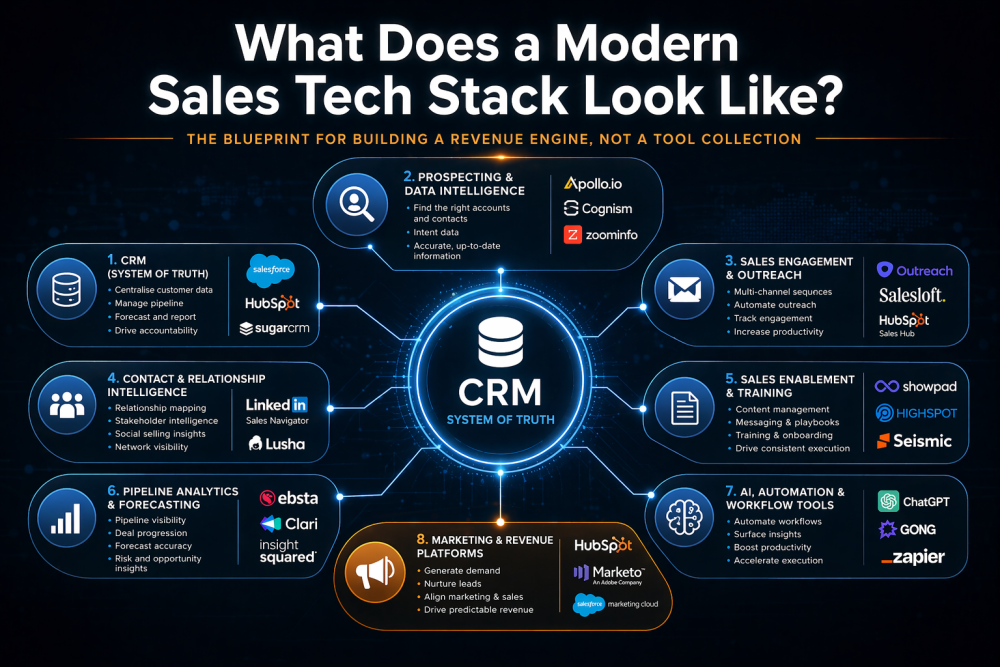
A modern sales tech stack has seven core layers, each with a distinct role.
1. CRM: The System of Truth
Your CRM is the foundation.
It should be the single source of truth for:
Customer data
Pipeline visibility
Opportunity progression
Forecasting
Examples include:
- Salesforce, https://www.salesforce.com
- HubSpot CRM, https://www.hubspot.com
- SugarCRM, https://www.sugarcrm.com
But here is the reality.
Most CRMs are underused.
Not because they are poor systems.
Because they are treated as reporting tools, not performance tools.
A modern CRM should answer one question:
“What do we need to do next to move this deal forward?”
2. Prospecting and Data Intelligence
Pipeline creation starts here.
These tools help you identify:
Target accounts
Decision makers
Contact details
Intent signals
Examples:
- Apollo, https://www.apollo.io
- Cognism, https://www.cognism.com
- ZoomInfo, https://www.zoominfo.com
Without accurate data, pipeline generation becomes guesswork.
With it, it becomes targeted and efficient.
3. Sales Engagement Platforms
These tools drive activity.
They enable:
Multi-channel outreach
Sequence automation
Engagement tracking
Examples:
- Outreach, https://www.outreach.io
- Salesloft, https://www.salesloft.com
- HubSpot Sales Hub https://www.hubspot.com
They reduce administrative effort and increase consistency.
But they must be used intelligently.
Automation without relevance creates noise.
4. Relationship and Contact Intelligence
Modern sales is multi-stakeholder.
You are not selling to one person.
You are influencing a group.
These tools provide visibility into:
Relationships
Networks
Stakeholder roles
Examples:
- LinkedIn Sales Navigator, https://www.linkedin.com/sales
- Lusha, https://www.lusha.com
They help sellers understand who matters, not just who is visible.
5. Sales Enablement and Training
This layer ensures consistency.
It provides:
Messaging
Content
Coaching
Training
Examples:
- Showpad, https://www.showpad.com
- Highspot, https://www.highspot.com
- Seismic, https://www.seismic.com
Enablement is often misunderstood.
It is not about content distribution.
It is about behaviour change.
6. Pipeline Analytics and Forecasting
This is where insight lives.
These tools help you understand:
Deal progression
Conversion rates
Pipeline risk
Forecast accuracy
Examples:
- Ebsta, https://www.ebsta.com
- Clari, https://www.clari.com
- InsightSquared https://www.insightsquared.com/
Most forecasts are based on opinion.
Analytics turns them into evidence.
7. AI and Automation Layer
This is the fastest-evolving layer.
It enhances:
Productivity
Insight generation
Decision support
Examples:
- ChatGPT, https://www.openai.com
- Gong, https://www.gong.io
- Zapier, https://www.zapier.com
AI is not replacing sellers.
It is amplifying them.
The question is whether your organisation is using it intentionally.
8. Marketing and Revenue Platforms
Sales does not operate in isolation.
This layer drives:
Demand generation
Lead nurturing
Marketing alignment
Examples:
- HubSpot https://www.hubspot.com
- Marketo, https://www.marketo.com
- Salesforce Marketing Cloud https://www.salesforce.com
Revenue is a system.
And marketing is a critical part of it.
Case Study 1: The Overloaded Stack That Failed
A European technology company invested heavily in sales technology.
They had:
A leading CRM
Multiple data tools
Several engagement platforms
AI tools
Analytics dashboards
On paper, it looked impressive.
In reality, it was chaotic.
Sellers were switching between systems constantly.
Data was duplicated and inconsistent.
CRM adoption was low.
Forecasts were unreliable.
The problem was not the tools.
It was the lack of integration and clarity.
The organisation simplified the stack.
They reduced overlapping tools.
They integrated core systems.
They aligned tools with their sales process.
Within six months:
CRM adoption increased significantly.
Pipeline visibility improved.
Forecast accuracy increased.
Sales productivity improved.
The lesson?
More tools do not equal better performance.
Better systems do.
Case Study 2: The Integrated Revenue Engine
A global B2B services company took a different approach.
They designed their stack around behaviour.
Their structure:
CRM at the centre, Salesforce
Data layer, Cognism
Engagement layer, Outreach
Analytics layer, Ebsta
Enablement layer, Showpad
AI layer, Gong and ChatGPT
But the difference was not the tools.
It was how they were used.
Every activity fed into the CRM.
Every meeting was tracked and analysed.
Every deal had clear qualification criteria.
Every manager used data to coach.
The result:
Higher quality pipeline
Faster deal progression
Improved win rates
Stronger alignment between sales and delivery
Technology did not drive this.
Discipline did.
Technology enabled it.
What an Optimal Sales Tech Stack Looks Like
A high-performing sales tech stack is:
Simple
Integrated
Aligned to process
Focused on behaviour
A typical “clean stack” might look like:
CRM: Salesforce
Data: Apollo or Cognism
Engagement: Outreach
Analytics: Ebsta or Clari
Enablement: Showpad
AI: ChatGPT and Gong
Not excessive.
Not fragmented.
Just aligned.
The difference between a good stack and a poor one is not the tools.
How to Make It Work
It is the principles behind it.
1. One Source of Truth
All data flows into the CRM.
2. Integration Over Duplication
Tools must work together seamlessly.
3. Behaviour First
Technology supports how your team sells.
4. Simplicity Wins
Fewer tools, used well, outperform many tools used poorly.
5. Adoption Is Everything
If your team does not use it, it has no value.
Leadership Insight
Sales leaders often focus on selecting tools.
But the real leverage is in defining:
How the tools will be used
What behaviours they support
How performance will be measured
Because technology does not fix weak sales processes.
It exposes them.
Final Thought
A modern sales tech stack is not about technology.
It is about clarity.
Clarity of process.
Clarity of behaviour.
Clarity of execution.
When built correctly, it:
Reduces friction
Improves visibility
Enhances decision making
Accelerates revenue
When built poorly, it does the opposite.
So do not ask:
“What tools should we buy?”
Ask:
“What system do we need to build?”
Because the teams that win are not the ones with the most technology.
They are the ones with the most intentional technology.
Subscribe to Simon Hazeldine’s
“More Sales, More Often, More Margin” newsletter.
Simon’s regular newsletter contains powerful and practical sales and negotiation
strategies, tactics, and tips to help you to grow your revenue and bottom-line profits.
About the author
Simon Hazeldine works internationally as a revenue growth and sales performance speaker, consultant, and coach. He empowers his clients to get more sales, more often with more margin.
He has spoken in over thirty countries and his client list includes some of the world’s largest and most successful companies.
Simon has a master’s degree in psychology, is the bestselling author of ten books that have been endorsed by a host of business leaders including multi-billionaire business legend Michael Dell and is co-founder of leading sales podcast “The Sales Chat Show”.
He is the creator of the neuroscience based “Brain Friendly Selling”® methodology.
Simon Hazeldine’s books:
- Neuro-Sell: How Neuroscience Can Power Your Sales Success
- Bare Knuckle Selling
- Bare Knuckle Negotiating
- Bare Knuckle Customer Service
- The Inner Winner
- How To Lead Your Sales Team – Virtually and in Person
- Virtual Selling Success
- How To Manage Your People’s Performance
- How To Create Effective Employee Development Plans
- Virtual Negotiation Success


