By
Simon Hazeldine
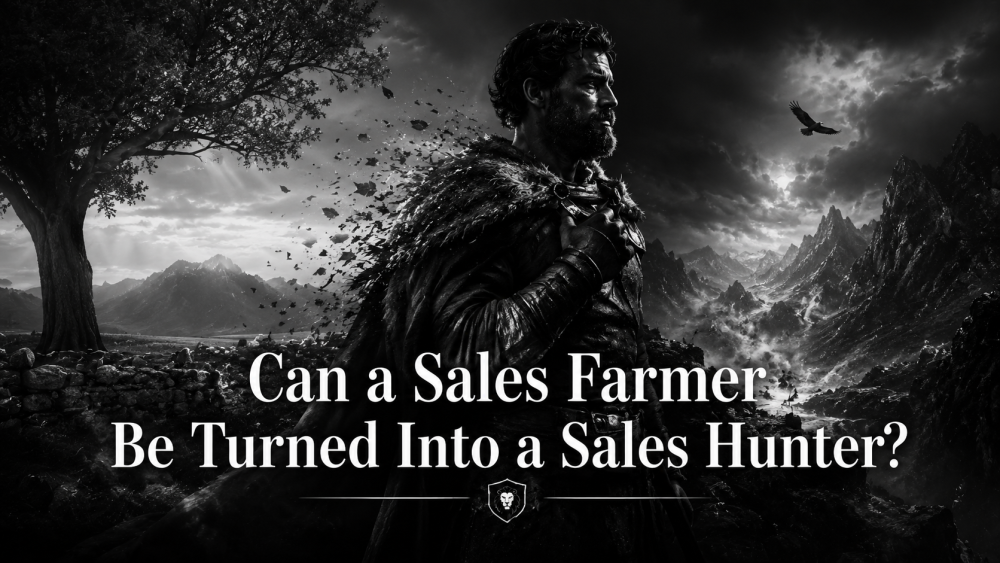
Can a sales farmer be turned into a sales hunter?
It is a question many sales leaders ask.
Usually with some frustration.
They look at their account managers and see strong relationships, deep customer knowledge, and trusted access to decision-makers.
Then they ask:
“Why are they not creating more opportunities?”
“Why are they not more proactive?”
“Why do they wait for customers to ask?”
“Why do they avoid prospecting?”
The answer is often misunderstood.
Yes, a farmer can become more hunter-like.
But only if we are clear about what we mean by hunting.
If we mean turning a highly relational, service-oriented account manager into a cold-calling, rejection-loving, new-logo hunter overnight, probably not.
At least not easily.
But if we mean developing proactive commercial behaviour, opportunity creation, confident questioning, value-led challenge, and expansion discipline, then yes.
Absolutely.
The key is not to change their personality.
The key is to build the behaviours.
The Problem with the Question
The phrase “turning a farmer into a hunter” can be unhelpful because it implies that hunting is a personality type.
It suggests that hunters are born, not built.
Some people are proactive.
Some people are not.
Some people can prospect.
Some people cannot.
Some people are commercial.
Some people are merely relational.
This is too simplistic.
Sales behaviour is shaped by identity, confidence, skill, incentives, leadership, and environment.
Many so-called farmers are not incapable of hunting.
They have simply been conditioned not to.
They have been rewarded for service, responsiveness, and relationship maintenance.
They have been trained to keep customers happy.
They have learned to avoid anything that might feel pushy, disruptive, or too sales-driven.
So when leaders suddenly ask them to “hunt”, they recoil.
Not because they lack ability.
Because it conflicts with how they see their role.
The Identity Shift
For many farmers, the first barrier is psychological.
They do not see themselves as opportunity creators.
They see themselves as trusted advisors, relationship managers, service partners, problem solvers, or customer protectors.
There is nothing wrong with that.
In fact, those qualities are commercially valuable.
The problem arises when trust becomes passive.
A farmer may think:
“I do not want to damage the relationship.”
“I do not want to be seen as selling.”
“I do not want to push.”
“I will raise it when the customer asks.”
This creates a commercial blind spot.
Because customers often do not ask.
They may not see the opportunity.
They may not understand the risk.
They may not know what else is possible.
They may be too busy dealing with the current issue.
If the account manager sees a way to create value and stays silent, they are not protecting the relationship.
They are limiting it.
The first shift is therefore this:
From “I manage the relationship”
To “I help the customer create more value”
That is the bridge between farming and hunting.
Farmers Have Advantages Hunters Often Lack
It is important to say this clearly.
Farmers are not second-class sellers.
In many situations, they have advantages that hunters would love to have.
They already have trust.
They already have access.
They already understand the customer’s world.
They already know the politics.
They already see delivery issues, strategic priorities, and unmet needs.
The farmer’s challenge is not access.
It is activation.
They are often sitting on opportunity but not converting insight into commercial action.
That means the development focus should not simply be “teach them to prospect”.
It should be:
Teach them to spot opportunity.
Teach them to create commercial conversations.
Teach them to ask expansion questions.
Teach them to connect problems to outcomes.
Teach them to position value confidently.
Teach them to ask for next steps.
That is how farmers become growth creators.
The Five Behaviours Farmers Need to Develop
If you want farmers to become more hunter-like, focus on five practical behaviours.
1. Commercial Curiosity
Farmers often know the customer well, but they may know them operationally rather than commercially.
They know what is happening.
But do they know why it matters?
Commercial curiosity means asking questions such as:
“What are your biggest priorities over the next 12 months?”
“What risks could affect delivery?”
“Where are you seeing friction as the business grows?”
“What happens if this issue is not addressed?”
“What would success look like commercially?”
These questions help farmers move beyond service conversations into opportunity conversations.
2. Problem Expansion
Many farmers are excellent at solving the problem the customer raises.
But growth often comes from helping the customer see the wider issue.
For example, the customer says:
“We need help with this implementation.”
The farmer could simply respond.
Or they could ask:
“If this implementation is delayed, what impact does that have on the wider programme?”
“Who else is affected if this does not go smoothly?”
“What would this free up if we got it right?”
This is not selling aggressively.
It is expanding the conversation.
3. Value Translation
Farmers often understand the service or solution, but may not always translate it into commercial value.
They may talk about support, delivery, features, or responsiveness.
They need to connect these to outcomes:
Time saved.
Risk reduced.
Cost avoided.
Revenue protected.
Productivity improved.
Customer experience strengthened.
This is where the relationship becomes commercial.
Not transactional.
Commercial.
4. Proactive Opportunity Creation
Farmers often wait for signals.
Hunters create them.
This does not mean farmers need to become aggressive prospectors.
It means they need to schedule proactive growth conversations.
For example:
Quarterly value reviews.
Strategic planning sessions.
Risk reviews.
Innovation conversations.
Stakeholder expansion meetings.
These conversations create opportunity naturally because they focus on the customer’s future, not just the current service.
5. Next-Step Confidence
Many farmers have good conversations but weak closes.
They discuss possibilities.
They explore ideas.
They identify needs.
Then they leave momentum vague.
A more hunter-like farmer secures the next commitment.
For example:
“Would it make sense to bring your operations lead into the next conversation?”
“Shall we schedule a session to explore what this could look like?”
“Would it be useful if we mapped the business case together?”
Opportunity creation requires movement.
Movement requires commitment.
What Not to Do
If you want farmers to become more hunter-like, do not simply increase their target and tell them to be more proactive.
That rarely works.
Do not shame them for being relationship-oriented.
That destroys confidence.
Do not force them into scripts that feel unnatural.
They will resist.
Do not assume prospecting training alone will solve the problem.
It may not.
The issue is often not technique.
It is role identity, commercial confidence, and behavioural rhythm.
The Farmer-to-Hunter Development Plan
Here is a practical approach.
Step 1: Reframe the Role
Position growth as value creation, not selling.
The message should be:
“You are not here to push more products. You are here to help customers recognise risks, opportunities, and better ways forward.”
Step 2: Define Expansion Triggers
Give farmers clear signals to look for.
Examples:
Customer growth.
New leadership.
Repeated service issues.
Underused capability.
Strategic change.
New regulation.
Competitor activity.
Budget cycles.
Operational bottlenecks.
Triggers make opportunity creation more concrete.
Step 3: Build Questioning Confidence
Train farmers to ask commercially useful questions.
Not pitch questions.
Thinking questions.
Step 4: Create a Growth Conversation Rhythm
Make proactive conversations part of the role.
For example:
Every strategic account should have a quarterly value review.
Every renewal should include a future opportunity conversation.
Every major service issue should include a risk and prevention discussion.
Step 5: Coach the Ask
Farmers often need help asking for the next step.
Rehearse language.
Build comfort.
Make commitment feel natural.
Can Every Farmer Become a New Business Hunter?
No.
Not every farmer will thrive in pure cold new-logo acquisition.
Some people are better suited to account expansion than prospecting into completely cold markets.
That is fine.
The goal is not to make everyone identical.
The goal is to increase commercial range.
Some farmers can become excellent new business hunters.
Others can become outstanding expansion sellers.
Both are valuable.
The mistake is assuming that because someone is not a natural hunter, they cannot create growth.
They can.
But the growth motion may be different.
Final Thought
Can a farmer become a hunter?
Sometimes.
But the better question is:
Can a farmer become a proactive commercial growth creator?
Yes.
And in many businesses, that may be the bigger opportunity.
Because farmers already have trust, insight, and access.
If you add commercial curiosity, value translation, proactive opportunity creation, and next-step confidence, you unlock enormous growth potential.
Do not try to turn farmers into someone else.
Help them become more commercially powerful versions of themselves.
That is how account managers become growth drivers.
And that is how organisations stop leaving revenue buried inside existing relationships.
Subscribe to Simon Hazeldine’s
“More Sales, More Often, More Margin” newsletter.
Simon’s regular newsletter contains powerful and practical sales and negotiation
strategies, tactics, and tips to help you to grow your revenue and bottom-line profits.
About the author
Simon Hazeldine is a leading sales psychology and sales performance expert, helping organisations improve sales results through neuroscience-based selling, sales leadership, negotiation and practical behaviour change.
He works internationally as a revenue growth and sales performance speaker, consultant, and coach. He empowers his clients to get more sales, more often with more margin.
Simon has spoken in over thirty countries and his client list includes some of the world’s largest and most successful companies.
He has a master’s degree in psychology, is the bestselling author of ten books that have been endorsed by a host of business leaders including multi-billionaire business legend Michael Dell and is co-founder of leading sales podcast “The Sales Chat Show”.
Simon is the creator of the neuroscience based “Brain Friendly Selling”® methodology.
Simon Hazeldine’s books:
- Neuro-Sell: How Neuroscience Can Power Your Sales Success
- Bare Knuckle Selling
- Bare Knuckle Negotiating
- Bare Knuckle Customer Service
- The Inner Winner
- How To Lead Your Sales Team – Virtually and in Person
- Virtual Selling Success
- How To Manage Your People’s Performance
- How To Create Effective Employee Development Plans
- Virtual Negotiation Success