By
Simon Hazeldine
Most sales processes are built around seller activity.
Prospect.
Qualify.
Present.
Propose.
Negotiate.
Close.
That makes sense from the seller’s perspective.
It gives structure.
It creates stages.
It helps managers track pipeline.
It gives CRM systems something to measure.
But here is the problem.
Buyers do not make decisions according to your CRM stages.
They move through psychological states.
Attention.
Trust.
Relevance.
Confidence.
Risk reduction.
Commitment.
And if your sales process does not match how the buyer’s brain actually works, your sellers will often feel busy without being influential.
They may complete the sales activities.
But they may not move the buyer psychologically.
That is why many deals stall even when the process appears to be progressing.
A discovery call happens.
A presentation happens.
A proposal is sent.
A follow-up is scheduled.
But inside the buyer’s mind, the real decision has not moved forward.
This is the gap sales people and sales leaders need to close.
The future of sales performance will not just come from better process compliance.
It will come from better buyer understanding.
The Seller Process Versus the Buyer Brain
Traditional sales processes are useful.
But they are incomplete.
They describe what the seller should do.
They do not always explain what the buyer needs to feel, believe, understand, and resolve before they can move forward.
For example, the seller may believe they are in the presentation stage.
But the buyer may still be asking:
“Do I trust this person?”
The seller may believe they are in the proposal stage.
But the buyer may still be thinking:
“Do I really understand the value?”
The seller may believe they are in the closing stage.
But the buyer may still be worrying:
“What if this goes wrong?”
This is why sellers must learn to read the buyer’s psychological state, not just follow the sales stage.
The question is not only:
“What stage is the deal at?”
The better question is:
“What does the buyer’s brain need next?”
Stage 1: Prospecting, Winning the Brain’s Attention Filter
The buyer’s brain is designed to filter.
It ignores most things.
This is not because buyers are rude. It is because they are overwhelmed.
They are receiving emails, messages, notifications, internal demands, customer issues, project updates, and competing priorities all day long.
So the brain asks one fast question:
“Is this relevant to me?”
If the answer is no, the message disappears.
This is why generic prospecting fails.
Messages that begin with the seller’s company, product, history, features, awards, or “I hope you are well” often place the cognitive burden on the buyer.
The buyer has to work out why the message matters.
And if the brain has to work too hard, it filters the message out.
Seller objective
Create rapid relevance.
Best questions
“What is this buyer likely under pressure to achieve?”
“What problem would they immediately recognise?”
“What commercial trigger makes this message timely?”
Best evidence
Industry trend, business event, relevant risk, commercial trigger, peer comparison, or known strategic priority.
Common mistake
Leading with product instead of relevance.
Coaching prompt for leaders
“Does this message make the buyer feel, ‘This is about me,’ within the first five seconds?”
Stage 2: Discovery, Creating Psychological Safety
Discovery is not just information gathering.
It is trust building.
Buyers reveal more when they feel psychologically safe. They disclose more when they believe the seller is competent, credible, curious, and not simply hunting for a pitch opportunity.
This matters because buyers often do not reveal the full problem immediately.
They may start with surface issues:
“We need better reporting.”
“We are reviewing suppliers.”
“We are looking at options.”
“We want to improve performance.”
Average sellers accept these statements too quickly.
Elite sellers create enough trust to explore what sits underneath.
The real issue may be risk.
Political pressure.
Missed targets.
Internal conflict.
Operational frustration.
Fear of making the wrong decision.
Discovery works when the buyer feels safe enough to think out loud.
Seller objective
Increase disclosure and uncover deeper drivers.
Best questions
“What is driving the need to look at this now?”
“What happens if this does not change?”
“Who else is affected by this issue?”
“What would make this a successful decision internally?”
Best evidence
Relevant experience, pattern recognition, examples from similar situations, and careful summarising.
Common mistake
Asking surface-level qualification questions and calling it discovery.
Coaching prompt for leaders
“Did the seller uncover impact, urgency, stakeholders, and decision dynamics, or just gather basic information?”
Stage 3: Presentation, Reducing Cognitive Load
Many sales presentations fail because they are too heavy.
Too much information.
Too many slides.
Too many features.
Too many claims.
Too many words.
The seller thinks more information creates more persuasion.
It often creates the opposite.
The buyer’s brain has limited working memory. When information becomes too complex, the brain struggles to process it. When the brain struggles, it does not become more persuaded. It becomes more cautious.
Cognitive overload creates decision resistance.
This is why clarity is not cosmetic.
Clarity is commercial.
A strong sales presentation should make the buyer think:
“I understand the problem more clearly.”
“I understand why this matters.”
“I understand how this solution helps.”
“I understand what makes this different.”
“I understand what should happen next.”
If the buyer feels mentally tired, confused, or overloaded, persuasion weakens.
Seller objective
Make the value easy to understand, remember, and repeat.
Best questions
“Which part of this matters most to you?”
“Where does this connect most strongly to your current priorities?”
“What would your internal stakeholders need to understand clearly?”
Best evidence
Simple commercial proof, short case examples, before and after comparisons, and visual clarity.
Common mistake
Using the presentation to transfer information instead of shaping understanding.
Coaching prompt for leaders
“Could the buyer explain our value to someone else in one clear sentence?”
Stage 4: Proposal, Making Clarity Beat Complexity
A proposal is not a document.
It is a decision tool.
Too many proposals are written to describe the seller’s offer rather than help the buyer make a confident decision.
They include background, methodology, credentials, scope, pricing, assumptions, and terms.
All useful.
But not always persuasive.
The buyer reading the proposal is usually trying to answer:
“Is this the right option?”“Can I justify this internally?”“What value will it create?”“What risks are involved?”“What will others challenge?”“What happens if we do nothing?”
A strong proposal should reduce uncertainty.
It should make the business case clear.It should make the risk manageable.It should make the value easy to defend.It should make the next step obvious.
The best proposals are not necessarily the longest.
They are the clearest.
Seller objective
Help the buyer justify action internally.
Best questions
“What will your internal stakeholders need to see in the proposal?”“What questions are finance, procurement, or operations likely to raise?”“What would make this easier to support internally?”
Best evidence
Clear ROI logic, risk reduction, implementation plan, proof points, success measures, and decision criteria alignment.
Common mistake
Sending a proposal that explains the solution but does not help the buyer sell the decision internally.
Coaching prompt for leaders
“Does this proposal help the buyer make the decision, or does it simply describe what we do?”
Stage 5: Negotiation, Understanding Loss Aversion and Fairness
Negotiation is emotional.
Even in rational business environments, buyers respond strongly to perceived loss, risk, and fairness.
A buyer may want the outcome.
But they may still resist the price.
Why?
Because the price is certain and immediate.
The value may feel future-based and less certain.
This is why sellers must anchor the negotiation around value, impact, and cost of inaction before discussing concessions.
If the buyer is anchored only on price, the seller is in danger.
If the buyer is anchored on business impact, risk reduction, time saved, cost avoided, or revenue enabled, the conversation becomes stronger.
Fairness also matters.
Buyers often test price because they want to feel they have negotiated well. Sellers damage margin when they give too quickly. They teach the buyer that pressure works.
The better approach is trade-off discipline.
If the buyer asks for movement, the seller asks for movement in return.
Seller objective
Protect value while maintaining fairness.
Best questions
“Compared to the impact we are trying to create, where does the investment feel misaligned?”
“If we need to adjust investment, what could we adjust in scope, timing, support, or term?”
“What would make this feel like a fair commercial agreement for both sides?”
Best evidence
Cost of inaction, value delivered, implementation confidence, risk reduction, and comparison of outcomes rather than just price.
Common mistake
Discounting to relieve discomfort rather than negotiating strategically.
Coaching prompt for leaders
“Did the seller trade value, or simply give it away?”
Stage 6: Closing, Reducing Risk Before Asking for Commitment
Closing is often misunderstood.
Some sellers think closing is about excitement.
Creating urgency.
Pushing for action.
Asking confidently.
Driving the decision.
There is some truth in that.
But in complex B2B sales, closing is often more about reducing risk than increasing excitement.
The buyer may like the solution.
They may believe in the value.
They may accept the business case.
But they may still hesitate.
Why?
Because decisions create exposure.
What if implementation fails?
What if adoption is poor?
What if the board challenges the investment?
What if the incumbent supplier reacts?
What if the promised value does not materialise?
The buyer’s brain is not only evaluating upside.
It is protecting against downside.
So the seller’s job is to create confidence.
Confidence in the decision.
Confidence in the process.
Confidence in the implementation.
Confidence in the internal justification.
Confidence in the next step.
Seller objective
Make the next commitment feel safe, logical, and valuable.
Best questions
“What would need to be true for you to feel confident moving forward?”
“What risks do we need to manage before the next step?”
“Who else needs reassurance before this can progress?”
“What would make this decision easy to support internally?”
Best evidence
Implementation plan, stakeholder alignment, proof of success, risk management, success measures, and clear next steps.
Common mistake
Pushing for commitment before reducing perceived risk.
Coaching prompt for leaders
“What unresolved risk is stopping the buyer from committing?”
The Buyer Brain Map
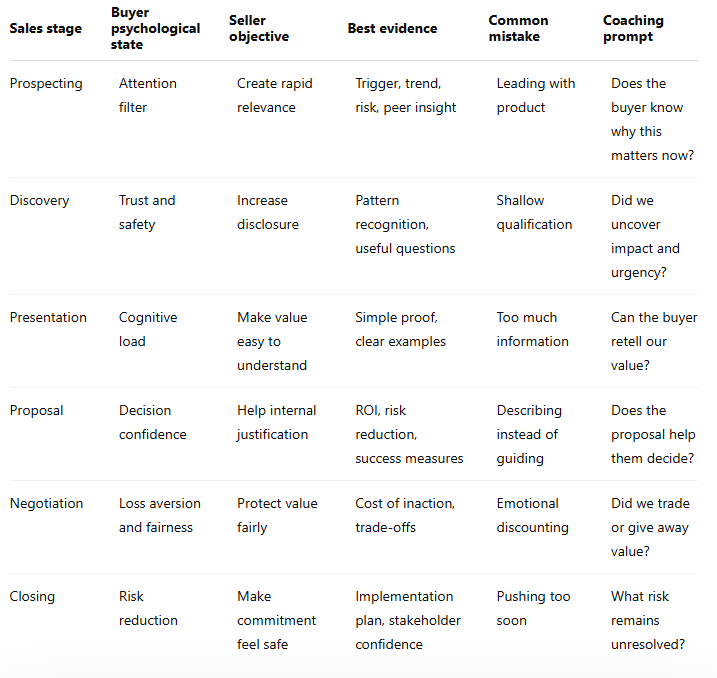
What This Means for Sales Leaders
Sales leaders need to coach beyond activity.
It is not enough to ask:
“How many calls?”
“How many meetings?”
“What stage is the deal at?”
“When will it close?”
Those questions matter.
But they do not reveal enough about buyer psychology.
Better questions include:
“Does the buyer see this as relevant?”
“Have we created enough trust for honest disclosure?”
“Is our message simple enough to travel internally?”
“Have we reduced the buyer’s perceived risk?”
“Is the buyer emotionally and commercially ready to commit?”
This is where sales coaching becomes more powerful.
You are no longer just managing the process.
You are coaching the psychology of progress.
Final Thought
Your CRM shows where the seller thinks the deal is.
The buyer’s brain determines whether the deal is really moving.
That distinction matters.
Most sales processes are built around seller activity.
But buying decisions are shaped by psychological states.
Attention.
Trust.
Relevance.
Clarity.
Fairness.
Risk reduction.
Commitment.
If sellers understand these states, they can sell with more precision.
They ask better questions.
They present with more clarity.
They negotiate with more discipline.
They close with more confidence.
The future of sales effectiveness will belong to teams that understand not just what sellers should do, but what buyers need to experience.
That is the Buyer Brain Sales Process.
Subscribe to Simon Hazeldine’s
“More Sales, More Often, More Margin” newsletter.
Simon’s regular newsletter contains powerful and practical sales and negotiation
strategies, tactics, and tips to help you to grow your revenue and bottom-line profits.
About the author
Simon Hazeldine is one of the leading sales psychology and sales performance experts, helping organisations improve sales results through neuroscience-based selling, sales leadership, negotiation and practical behaviour change.
He works internationally as a revenue growth and sales performance speaker, consultant, and coach. He empowers his clients to get more sales, more often with more margin.
Simon has spoken in over thirty countries and his client list includes some of the world’s largest and most successful companies.
He has a master’s degree in psychology, is the bestselling author of ten books that have been endorsed by a host of business leaders including multi-billionaire business legend Michael Dell and is co-founder of leading sales podcast “The Sales Chat Show”.
Simon is the creator of the neuroscience based “Brain Friendly Selling”® methodology.
Simon Hazeldine’s books:
- Neuro-Sell: How Neuroscience Can Power Your Sales Success
- Bare Knuckle Selling
- Bare Knuckle Negotiating
- Bare Knuckle Customer Service
- The Inner Winner
- How To Lead Your Sales Team – Virtually and in Person
- Virtual Selling Success
- How To Manage Your People’s Performance
- How To Create Effective Employee Development Plans
- Virtual Negotiation Success